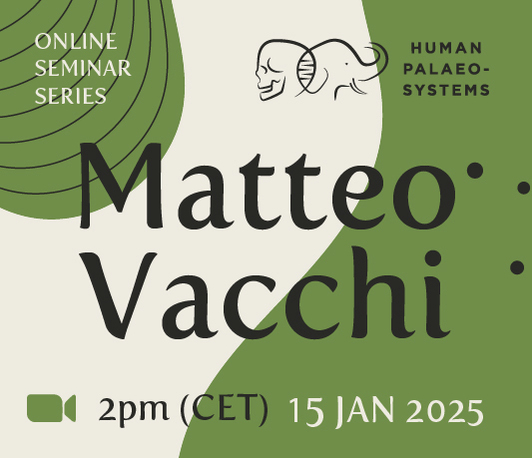
2025 Events

Graphic announcing Palaeosystems in Focus Seminar by Lucy van Dorp on 18 Nov 2025 at 2pm CET

Uncovering the Drivers of Pathogen Evolution from Ancient DNA to Modern Disease

Linking ancient DNA with modern genomic data provides a powerful framework for examining the evolution of pathogens and their hosts over centuries. Applied to microorganisms, ancient DNA approaches can recover lineages absent from contemporary sampling, expanding our view of past diversity. Temporal calibration points refine estimates of lineage ages and mutation rates, and increasingly enable the reconstruction of gene gain and loss chronologies. In this talk, I will discuss how time‐resolved approaches applied to pathogens can illuminate the processes that have shaped their diversity and adaptation, offering deeper insight into the forces influencing major disease challenges from the past to the present. [more]
This presentation explores three global Decision Theater cases: Arizona's water scarcity, Israel's tech-driven solutions, and China's Yellow River management. It highlights how these diverse approaches offer valuable insights for German water policy. Through comparative analysis, we examine transferable strategies and innovations, emphasising the importance of learning from others to shape adaptive, sustainable water management practices. [more]
Multiple monitors show images in a dark room. Text reads: Decision Theater Ideathon - Apply by 4 October 2025

Decision TheaterTM Ideathon

Berlin Science Week
Arizona State University and the Max Planck Institute of Geoanthropology invite you to an immersive ideathon on 6–7 November in Berlin. Fifty professionals from politics, urban development, AI, art, culture, and creative tech will collaborate in interdisciplinary teams to explore new applications for the Decision Theater™ decision-making tool. [more]

WE-Heraeus Symposium: Revisiting the History of Quantum Physics

On the occasion of the centenary of quantum theory, this international workshop brings together world-leading experts to synthesize recent scholarship on the history of quantum physics. The workshop explores key themes including the genesis of quantum mechanics, its social, cultural, and institutional contexts, interpretation debates, the role of women in the field, and the postwar expansion of quantum theory into areas like quantum field theory, condensed matter physics, and quantum information. The event offers an opportunity to reassess the past century and shape a future research agenda for the history of quantum physics. [more]

CONNECTING URBANISM ACROSS TIME AND SPACE

Weimarer Kontroversen in Berlin | Sag, wie hast du´s mit dem Weltuntergang?

Cutting Edge: Quantifying Complexity in Stone Tools

The evolution of human niche size in East Asia across the Pleistocene

Humans can thrive in nearly all terrestrial environments, exhibiting exceptional ecological flexibility among primates. However, it remains unclear how and when this flexibility first emerged in the human lineage. In this talk, I present a study addressing this question in the East Asian context. [more]
On 22th August 2023, our dear colleague Elisabeth de Boer sadly died at the age of 57, cutting short a promising career in Japanese Historical Linguistics. Elisabeth was a respected teacher of Japanese and linguistics at the Universities of Leiden and Bochum. Her researched challenged several so-called teisetsu or ‘accepted opinions’ encountered in the field. Among others, Elisabeth showed that Japanese is better described as a restricted tone language than as a pitch-accent language; that Kyōto-type dialects have been less conservative than dialects to their east and west and that the commonly accepted binary tree structure of Japonic is in need of revision. Moreover, Elisabeth did not shy away from interdisciplinary approaches, integrating linguistic evidence with archaeological and genetic findings to illuminate ancient population movements across the Japanese Islands. [more]
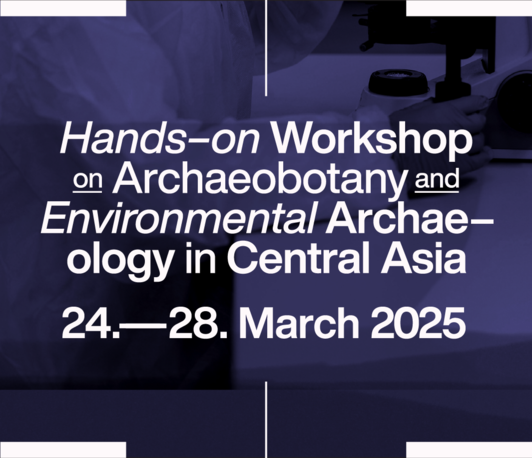
Deep-time, large-scale perspectives on biodiversity and ecosystems - implications for biosphere stewardship in the Anthropocene

Human Palaeosystems in Focus

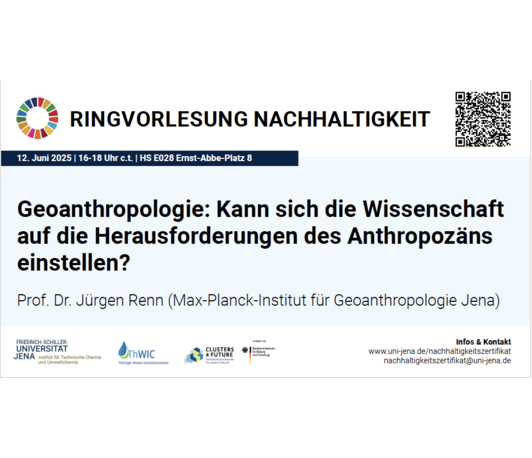
Geoanthropologie: Kann sich die Wissenschaft auf die Herausforderungen des Anthropozäns einstellen?

Ringvorlesung Nachhaltigkeit: Ringvorlesung Nachhaltigkeit - Vortrag von Prof. Dr. Jürgen Renn
The lecture discusses the Anthropocene as a new geological era in which humans have become the decisive influencing factor for the Earth system. In response to this fundamental transformation, geoanthropology is presented as a transdisciplinary research approach that examines the interactions between global society and the Earth system. Using the example of the energy transition, the lecture highlights the discrepancy between scientific knowledge and social action and argues for a systemic understanding of complex transformation processes. The central thesis is that the challenges of the Anthropocene can only be overcome through integrative approaches that take into account the co-evolution of technosphere and planetary processes. [more]
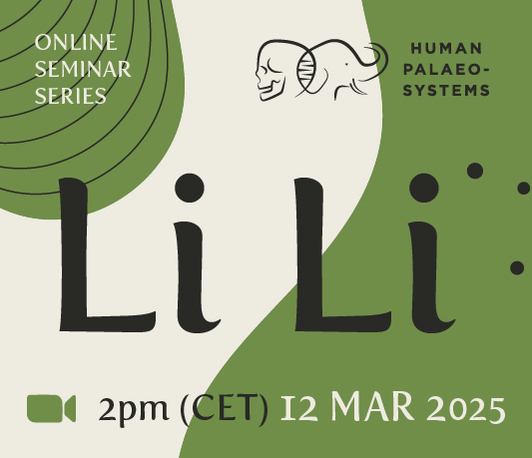
Using Palaeoecology to uncover colonization processes in Western Mediterranean islands

Human Palaeosystems in Focus
Go to Editor View