2023 Events

The Anthropocene Engine

  • Date: Dec 15, 2023
  • Time: 11:00 AM c.t. (Local Time Germany)
  • Speaker: Manfred D Laubichler, Arizona State University and Santa Fe Institute
  • Location: Hybrid Format - Max Planck Institute of Geoanthropology, seminar room Villa V.14 and Zoom
  • Room: Villa V14 und Zoom
  • Host: Max Planck Institute of Geoanthropology

Bridging the Gap - Integrating Historical Knowledge and Complex Human-Environmental Systems Modelling

  • Start: Dec 12, 2023
  • End: Dec 13, 2023
  • Speaker: Various
  • Location: Max Planck Institute of Geoanthropology
  • Host: Ricardo Fernandes & Adam Izdebski
This interdisciplinary workshop will bring together a diverse group of historians, archaeologists, complex systems modellers, and sustainability experts. The shared objective is to explore research strategies that can generate actionable knowledge to inform policies addressing the escalating climate crisis. [more]

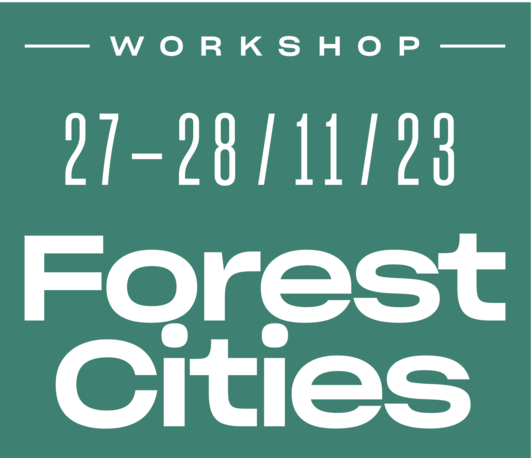
Workshop Forest Cities: Multidisciplinary Approaches to Urbanism in the Amazon/ Project Launch Resilient

  • Start: Nov 27, 2023
  • End: Nov 28, 2023
  • Speaker: Various
  • Location: Hybrid Format - Max Planck Institute of Geoanthropology, seminar rooms Villa V.03 & V.14
  • Host: Patrick Roberts & Danielle Heberle

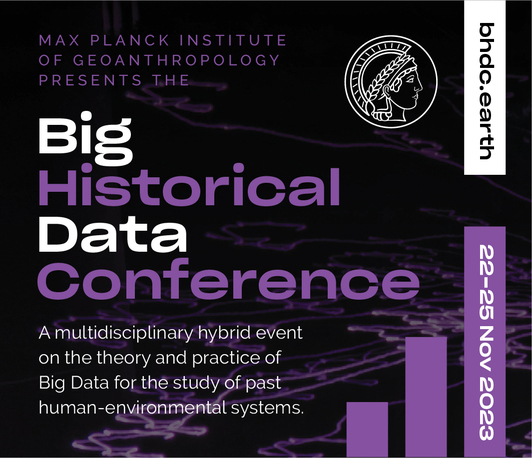
Big Historical Data Conference

  • Start: Nov 22, 2023 09:00 AM (Local Time Germany)
  • End: Nov 25, 2023 04:30 PM
  • Location: Max Planck Institute of Geoanthropology
  • Host: Systems Archaeology Research Group
  • Contact: bhdc@gea.mpg.de
The Max Planck Institute of Geoanthropology will host the first Big Historical Data Conference from 22-25 November 2023 [more]

3. MINT-FESTIVAL JENA 2023

  • Start: Sep 26, 2023
  • End: Sep 28, 2023
  • Speaker: Various
  • Location: Campus Ernst-Abbe-Platz der Friedrich-Schiller-Universität Jena
  • Host: Friedrich-Schiller-Universität
  • Contact: mint@uni-jena.de

Announcing the Proposed GSSP Candidate Site of the Anthropocene

  • Date: Jul 11, 2023
  • Time: 07:00 PM - 08:00 PM (Local Time Germany)
  • Speaker: Jürgen Renn, Bernd Scherer, Katrin Klingan, Colin Waters, Simon Turner, Principal Investigators of the proposed Anthropocene GSSP candidate site
  • Host: Georg Schäfer, Christoph Rosol, Jürgen Renn, Lina Schwab
  • Contact: dept1-events@mpiwg-berlin.mpg.de

Historical Waterscapes in Crosscultural Perspective

  • Start: Jul 5, 2023 02:00 PM (Local Time Germany)
  • End: Jul 7, 2023 04:30 PM
  • Speaker: Various
  • Location: MPI of Geoanthropology
  • Host: Department of Structural Changes of the Technosphere
  • Contact: rennoffice@gea.mpg.de
This workshop aims at a comparative study of historical waterscapes in different sites across the world by looking at the epistemological connection between cosmological and ecological knowledge in water-landscapes engineering. In doing so, we intend to addresses one of the most urgent questions of today’s hydrogeology, which relates to the natural-cultural nexus, as indicated in the IX strategic plan of the UNESCO Intergovernmental Hydrological Program: “What is the role of water in… the dynamics of human civilization, and what are the implications for contemporary water management?” [more]

ResearchTheatre and Science Slam (in English)

  • Date: Jun 23, 2023
  • Time: 07:00 PM - 09:00 PM (Local Time Germany)
  • Speaker: Dr. Ricardo Fernandes & various
  • Location: Altes Rathaus, Markt 9, 37073 Göttingen & Livestream
  • Host: Max-Planck-Society

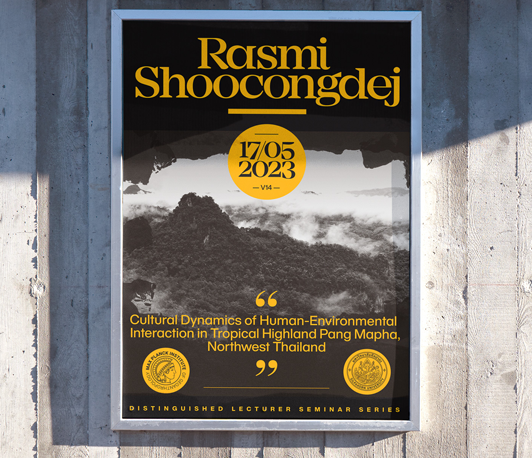
Cultural Dynamics of Human-Environmental Interaction in Tropical Highland Pang Mapha, Northwest Thailand

  • Date: May 17, 2023
  • Speaker: Rasmi Shoocongdej, Ph.D.
  • Department of Archaeology, Faculty of ArchaeologySilpakorn University, Bangkok
  • Location: Max Planck Institute of Geoanthropology
  • Room: Villa V14
  • Host: Department of Archaeology
  • Contact: richardson@shh.mpg.de
Over the past few years, archaeologists have made significant progress in understanding the processes of cultural and social changes documented in the Late and Post-Pleistocene archaeological record in Southeast Asian seasonal tropical environments. This talk explores the interactions between prehistoric humans and their environments through the study of adaptation as a key change in human behavioral patterns both synchronically and diachronically (ca. 32,000 – 1,100 B.P.). [more]

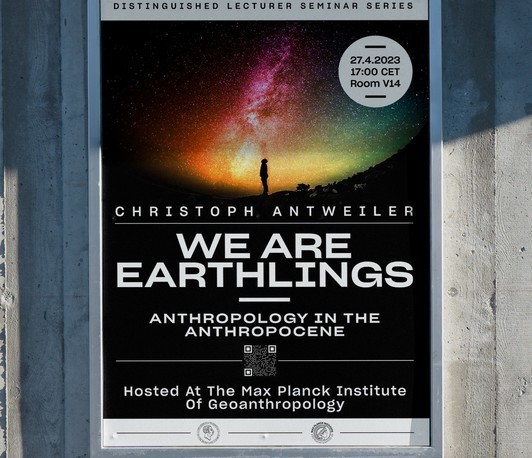
We are Earthlings – Anthropology in the Anthropocene

  • Date: Apr 27, 2023
  • Time: 05:00 PM - 06:00 PM (Local Time Germany)
  • Speaker: Christoph Antweiler, University Bonn
  • Speaker Christoph Antweiler born in 1956, is an cultural anthropologist and Senior Professor of Southeast Asian Studies at the Institute of Oriental and Asian Studies at the University of Bonn, Germany. He studied geology and palaeontology (Diploma) and then cultural anthropology (Ph.D.) in Cologne. His main research fields are cognition, local knowledge, urban culture, ethnicity and anthropogenic ecological change. His main theoretical interests are socio-cultural evolution, human universals and vernacular cosmopolitanism. His main research region is Southeast Asia, especially Indonesia.Among his book publications are: Was ist den Menschen gemeinsam? (Darmstadt: WBG, 22012), Inclusive Humanism. Anthropological Basics for a Realistic Cosmopolitanism (Taipei: National Taiwan University Press, 2012), Our Common Denominator. Human Universals Revisited (New York and Oxford: Berghahn Books 2016, pb 2018) and recently Anthropology in the Anthropocene (in German, Darmstadt: WBG, 2022). Antweiler is a member of the Academia Europaea (London).
  • Location: Zoom: https://eu01web.zoom.us/j/61683259842
  • Host: Department Structural Changes of the Technosphere
  • Contact: schwab@gea.mpg.de

Paleo Talks Seminar Series - Sapiens in South Asia: Multi-faceted story of peopling in the Indian continent

  • Date: Apr 26, 2023
  • Time: 11:58 AM - 03:30 PM (Local Time Germany)
  • Speaker: Various
  • Location: Zoom
  • Host: Department of Archaeology
  • Contact: gjha@shh.mpg.de
Paleo Talks presents "Sapiens in South Asia: Multi-faceted story of peopling in the Indian continent" (SSA) in association with the Department of Archaeology, MPI-GEA. This series aims to discuss current narratives of modern human arrival and expansion in the Indian subcontinent. Recent archaeological and genetic research postulate South Asia as a key region on the proposed dispersal routes of Modern Human expansion. Despite the importance of the region, however, archaeological data from South Asia rarely feature in discussions of human evolution, and little attempt has been made to bring South Asia's archaeological record to bear on discussions of its unique population dynamics. SSA will curate 15 exclusive sessions to review and discuss different facet of evolution of anatomical Modern Humans in Indian subcontinent, covering themes of paleolithic progression, genetics, ecology, and paleoanthropology. [more]

Rethinking the Evolutionary History of Hominin Populations in South Asia

Sapiens in South Asia
  • Date: Apr 26, 2023
  • Time: 10:00 AM - 11:00 AM (Local Time Germany)
  • Speaker: Prof Michael Petraglia
  • Director, ARCHE, Griffith University, Australia
  • Location: Zoom
  • Host: Department of Archaeology
  • Contact: gjha@shh.mpg.de
In the past several decades, there have been profound changes in our understanding of the evolutionary history of hominin populations, with new insights on a range of topics, such as on the relationship between environmental variability and hominin demographic changes and the timing and routes of dispersals from Africa to Asia, The Indian subcontinent plays a key role in contributing to general theories about our evolutionary history given the range of ecosystems and the unique blend of behavoural information. The author has been involved in developing a number of working hypotheses about the evolution of hominin populations in South Asia from primary examination and study of the environmental, fossil and archaeological record. The aim of this presentation is to evaluate the overall record of South Asia and to examine how well a series of hypotheses have held up given recent controversies, debates and new knowledge. New and fresh propositions are needed to situate the splendid evolutionary record of South Asia into our wider evolutionary story. [more]

Technologies of the first Homo sapiens communities in Sri Lanka: Arrows, ochre, and monkey hunting

Sapiens in South Asia
  • Date: Apr 19, 2023
  • Time: 10:00 AM - 11:00 AM (Local Time Germany)
  • Speaker: Dr. Michelle Langley
  • ARCHE, Griffith University, Australia
  • Location: Zoom
  • Host: Department of Archaeology
  • Contact: gjha@shh.mpg.de
Archaeologists contend that it was our aptitude for symbolic, technological, and social behaviors that was central to Homo sapiens rapidly expanding across the majority of Earth’s continents during the Late Pleistocene. This expansion included movement into extreme environments and appears to have resulted in the displacement of numerous archaic human populations across the Old World. Tropical rainforests are thought to have been particularly challenging and, until recently, impenetrable by early H. sapiens. In this presentation, evidence for bow-and-arrow hunting toolkits alongside a complex symbolic repertoire from 48,000 years before present at the Sri Lankan site of Fa-Hien Lena—some of the earliest bow-and-arrow technology outside of Africa. As one of the oldest H. sapiens rainforest sites outside of Africa, this exceptional assemblage provides the first detailed insights into how our species met the extreme adaptive challenges that were encountered in Asia during global expansion. [more]
Of Forests and Grasslands: Human-Animal Palaeoecology in Late Pleistocene-Holocene Sri Lanka

  • Date: Apr 12, 2023
  • Time: 01:30 PM - 02:30 PM (Local Time Germany)
  • Speaker: Dr Noel Amano
  • Zooarchaeology Research Group Leaders, Department of Archaeology, MPI GEA
  • Location: Zoom
  • Host: Department of Archaeology
  • Contact: gjha@shh.mpg.de
The Wet Zone region of Sri Lanka has provided some of the earliest direct evidence of human utilization of rainforest resources anywhere in the world. Stable isotope analysis of human and animal remains, alongside detailed zooarchaeological analyses, have demonstrated reliance on rainforest resources as far back as 48,000 years ago. In this presentation, I summarize the results of our ongoing research on the fauna remains recovered from excavation of cave sites, including the results of our new investigations focusing on faunal remains from the Terminal Pleistocene and Holocene transition, a transition period which has remained relatively under-explored. Our new data provide important new insights on changes in human adaptations and the varying niches of exploited fauna through time as well as Early Holocene human mobility (i.e long-distance foraging and/or trade and contact with other groups). Our findings also provide new information on human-animal interactions, including human relationships with now regionally extirpated taxa. [more]

Stone tools, Species and Speculations: Thoughts on discussing evolutionary trajectories in the Indian Palaeolithic

Sapiens in South Asia
  • Date: Apr 8, 2023
  • Time: 02:30 PM - 03:30 PM (Local Time Germany)
  • Speaker: Prof. Shanti Pappu
  • Sharma Centre for Heritage Education, Chennai, India. Visiting Professor, SIAS, Krea University, India
  • Location: Zoom
  • Host: Department of Archaeology
  • Contact: gjha@shh.mpg.de
Debates on population migrations in South Asia necessarily require a consideration of the evolution of concepts on dispersals and cultural trajectories. Here, we present thoughts on the evolution of conceptual approaches and nomenclatures in Indian prehistory, with implications for current interpretations of the nature and timing of dispersals. We situate these issues in the context of our own long-term research in Tamil Nadu, with a focus on the sites of Attirampakkam and other sites in SE India. [more]

Late Quaternary human-environment relationship in India: perspective from plant lipids and multi-isotope (2H, 18O, 13C) analyses

Sapiens in South Asia
  • Date: Apr 3, 2023
  • Time: 02:30 PM - 03:30 PM (Local Time Germany)
  • Speaker: Dr. Deepak Jha
  • Postdoctoral Researcher, Department of Archaeology, MPI GEA
  • Location: Zoom
  • Host: Department of Archaeology
  • Contact: gjha@shh.mpg.de
The Quaternary period, also known as the "Age of Humans," is characterized by an abundant fossil record of Homo species around the globe. This period has undergone remarkable changes in global climate, leading to the extinction of numerous mammalian species and possibly influencing the evolution of Homo species. Although early Homo species' fossil records are absent from the Indian subcontinent, various stone tools/artefacts discovered from sedimentary deposits of the Quaternary age indicate the presence of prehistoric humans skilled in tool-making. Based on the morphology and typo-technology of excavated artefacts, it is suggested that prehistoric humans in the studied region used Paleolithic to Neolithic tools. However, the age of the prehistoric phase is still a matter of curiosity and needs further investigation. Therefore, understanding the role of climate in Homo evolution requires complete control over the age of prehistoric phases. [more]

Vārtā, a dialogue about "Sapiens in South Asia"

Sapiens in South Asia
  • Date: Mar 29, 2023
  • Time: 02:30 PM - 03:30 PM (Local Time Germany)
  • Speaker: 1. Prof. Sheila Mishra; 2. Prof. P. Ajithprasad; 3. Prof. Ravi Korisettar; 4. Dr. Bishnupriya Basak
  • 1. Retired professor of geoarchaeology and the Head of Department of the Department of Archaeology, Deccan College, Pune, India; 2. Retired professor and former head,Department of Archaeology & Ancient History, The M. S. University of Baroda; 3. ICHR Senior Academic Fellow, Dharwad, India; 4. Associate Professor, Department of Archaeology, University of Calcutta, India
  • Location: Zoom
  • Host: Department of Archaeology
  • Contact: gjha@shh.mpg.de
Paleo Talks and MPI-GEA is delighted to present “Vārtā”(Sanskrit noun for dialogue), a panel discussion that will discuss current narratives of Modern human arrival and evolution in Indian Subcontinent. This webinar is to be held on 29th March 2023 at 18:00 hrs (IST). The panel comprises of Prof. P. Ajithprasad, Dr Bishnupriya Basak, Prof. Ravi Korisettar and Prof. Sheila Mishra. The discussion is a part of Paleo Talk lecture series “Sapiens in South Asia: Multi-faceted Story of Peopling in Indian Subcontinent.” The series aims to decentralize the story of human evolution and discuss current narratives of modern human arrival and expansion in Indian subcontinent. [more]

An Early MIS 3 Lithic Assemblage from India

Sapiens in South Asia
  • Date: Mar 15, 2023
  • Time: 01:30 PM - 02:30 PM (Local Time Germany)
  • Speaker: Dr. Garima Khansili
  • Lecturer, North-eastern Hill University, Meghalaya, India
  • Location: Zoom
  • Host: Department of Archaeology
  • Contact: gjha@shh.mpg.de
The origin and timing of modern human dispersal is of great interest to various disciplines. Archaeological data over the past couple of decades has shown that microlithic technology was already present in the Indian subcontinent by early MIS 3. Microlithic blade technology is often considered as proxy for the presence of modern humans. At present, there are around ten archaeological sites within the Indian subcontinent that are dated within the early MIS 3 and associated with the microlithic blade technology. The talk shall focus on the lithic assemblage from a MIS 3 archaeological horizon from Mehtakheri. [more]

The generalist specialist: Exploring a unique Pleistocene ecological niche for our species

  • Date: Mar 8, 2023
  • Time: 01:30 PM - 02:30 PM (Local Time Germany)
  • Speaker: Dr. Patrick Roberts
  • isoTROPIC Independent Research Group Leader, MPI GEA
  • Location: Zoom
  • Host: Department of Archaeology
  • Contact: gjha@shh.mpg.de
Definitions of our species have tended to focus on fossils, genetics, or its unique capacities for symbolism, language, social networking, technological competence, and cognitive development. More recently, however, attention is increasingly turning towards humans’ ecological plasticity. In this talk, Patrick will provide a critical evaluation of existing archaeological and palaeo-environmental datasets relating to the Pleistocene (300-12 ka) dispersal of our species within and beyond Africa. He will argue, following comparison with the available information for other members of the genus Homo, that our species developed a new ecological niche, that of the ‘generalist specialist’. [more]

Microlithic occurrences in the central Narmada Basin, Madhya Pradesh

  • Date: Mar 1, 2023
  • Time: 01:30 PM - 02:30 PM (Local Time Germany)
  • Speaker: Dr Nupur Tiwari
  • Department of Humanities and Social Sciences, IIT Bombay
  • Location: Zoom
  • Host: Department of Archaeology
  • Contact: gjha@shh.mpg.de
In the Indian Subcontinent, contexts belonging to the Late Pleistocene to early Holocene period are dominated by records of hunter-gatherer behaviour in the form of microliths. Central India offered abundant resources of the required raw materials, rock shelters, open scrubland, water bodies, various flora and fauna in the lap of the Vindhyan and Gondwana ranges. The region must have regularly attracted foragers through its role as a critical biogeographic and cultural crossroads. Microlithic tool kit is synonymous with the prehistoric Homo sapiens (PHS). Research carried out in the central Narmada Basin paints a variant picture of microlithic producing hunter-gatherers. [more]

Breaching the Biogeographic Boundary: Early expansions of modern humans into monsoonal Asia

  • Date: Feb 22, 2023
  • Time: 01:30 PM - 02:30 PM (Local Time Germany)
  • Speaker: Dr. James Blinkhorn
  • Pan African Evolution Research Group, MPI-GEA
  • Location: Zoom
  • Host: Department of Archaeology
  • Contact: gjha@shh.mpg.de
Today, half of the world’s population live in regions dominated by the Asian Monsoon and are reliant upon it and the unique ecologies it supports for both water and food security. This talk will explore the first steps of early modern human populations into monsoonal Asia, focusing on western India [more]

Is there an archaeological signature for modern human migration from Africa through South Asia to Australia?

  • Date: Feb 18, 2023
  • Time: 09:00 AM - 10:00 AM (Local Time Germany)
  • Speaker: Prof Chris Clarkson
  • Professor, School of Social Science, Faculty of Humanities and Social Sciences, The University of Queensland, Australia
  • Location: Zoom
  • Host: Department of Archaeology
  • Contact: gjha@shh.mpg.de
This talk will examine the archaeological, fossil, genetic and dating evidence for the multiple dispersals of modern humans out of Africa, through South Asia and eventually on to Australia. Evidence from key sites along this arc will be examined, and in particular, the latest evidence from Australia and its relevance to this argument [more]

Behavioural or Biological? Recent Perspectives on the Origins and Evolution of Middle Palaeolithic Culture in South Asia

  • Date: Feb 1, 2023
  • Time: 01:30 PM - 02:30 PM (Local Time Germany)
  • Speaker: Devara Anilkumar
  • Dept of Archaeology & Ancient History, the Maharaja Sayajirao University of Boda, Vadodora, India
  • Location: Zoom
  • Host: Department of Archaeology
Preliminary investigation of Palaeolithic sites situated in the Gundlakamma and adjoining river basins, Andhra Pradesh, India, shed significant light on the origin and evolution of Middle Palaeolithic culture in South Asia. Lithic assemblages dated to mid-Middle Pleistocene suggest indigenous development and evolution of Middle Palaeolithic culture. The nature of these lithic assemblages and their geological and chronological context will be discussed. Further, the temporal evolution of these assemblages dated between >400 to 145 ka will be examined to understand the changes and similarities through time. [more]

Reconstructing the peopling of old-world South Asia: from modern to ancient genomes

  • Date: Jan 25, 2023
  • Time: 01:30 PM - 02:30 PM (Local Time Germany)
  • Speaker: Dr. Niraj Rai
  • Scientist & Group Head, Ancient DNA Lab at BSIP, Lucknow
  • Location: Zoom
  • Host: Department of Archaeology
  • Contact: gjha@shh.mpg.de
Dr. Niraj Rai will discuss the complex population structure of the Indian Sub-continent and future research directions to understand the deep ancestry components of South Asians at the Eurasian and global scales, patterns of admixture and migrations derived from studying ancient and modern genomes. [more]

Hypothesis compatibility, hypothesis testing, and Homo sapiens evolution in Southern Eurasia

  • Date: Jan 18, 2023
  • Time: 03:30 PM - 04:30 PM (Local Time Germany)
  • Speaker: Professor Sheela Athreya
  • Chancellor’s Fellow and Presidential Fellow, Department of Anthropology, Texas A&M University
  • Location: Zoom
  • Host: Department of Linguistic and Cultural Evolution
  • Contact: gjha@shh.mpg.de

Ancient Mobile & Sedentary Interactions in Inner Asia

  • Start: Jan 17, 2023 12:00 PM (Local Time Germany)
  • End: Jan 19, 2023 07:00 PM
  • Speaker: Various
  • Location: Hybrid
  • Room: Villa V14 and Zoom
  • Host: MPI GEA
  • Contact: dalmartello@shh.mpg.de
Central Asia comprises the vast expanse of biologically and culturally diverse lands between each of the great centers of agricultural origins. The people in this region linked Eurasia through commerce and the diffusion of technology and ideas. Despite their importance in shaping the modern world, these peoples are often overlooked in archaeological or historical treaties of the human narrative. For archaeologists working in this expanse, these issues of invisibility are primary obstacles to overcome. In the effort of understanding the role these ancient peoples played in shaping the cultures of the modern world, we have pulled together a group of top archaeological experts. We are focusing on the question of mobility, broadly speaking, including the diffusion of ideas and the movement of people. Mobility remains a central theme in Central Asian archaeology, whether discussing mobile pastoralists or merchants on the Silk Road, movement has dominated discourse. However, an increasing awareness of the prominence of sedentism, agricultural investment, and urban development in this highly diverse part of the world is raising questions about how to identify mobility and sedentism in prehistory and early history. In seeking to increase the general visibility of Central Asian peoples of the past, we will meet to discuss mobility and sedentism in the archaeological record of Central Asia. [more]
Go to Editor View